Does Claude Watermark AI-Generated Content? A QA Reality Check

Aug 25, 2026
Claude does not embed a hidden watermark in its plain text output, and Anthropic hasn't published one. What exists instead is imperfect statistical detection, plus whatever provenance your own pipeline chooses to log. If you need proof content came from Claude, you have to build that logging yourself.
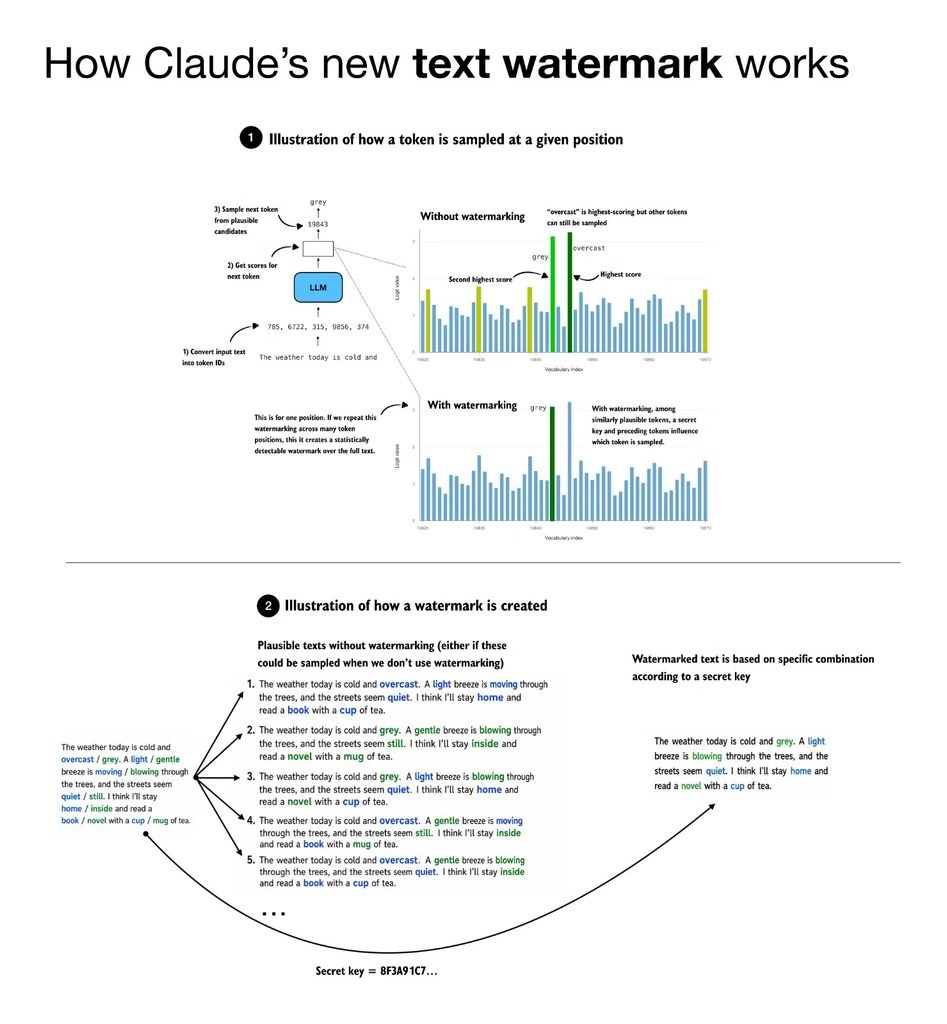
Ask ten QA engineers how to spot Claude-written text, and eight will still say some version of “there’s no way to tell.” As of August 2, 2026, that’s wrong. Supported Claude models weave an imperceptible watermark directly into generated text, and Claude attaches signed provenance metadata to generated files like SVGs, PNGs, and JPGs. It’s real, it’s live across Claude’s products, and it still won’t save a test plan that assumes every piece of AI content confesses on its own. Here’s what’s actually documented, what it doesn’t cover, and what to test instead.
The Short Answer
Claude does mark its own output now, but not the way office folklore describes it. There’s no visible tag, no “AI-generated” stamp sitting in the text. Instead, supported models fold a statistical signal into the writing itself — imperceptible, meaning you can’t see it, read it, or feel it change the tone, quality, or meaning. Generated files get a separate layer: signed provenance metadata built on the C2PA industry standard. Neither layer covers everything you’ll run into, and neither one is proof beyond doubt. Provenance is a real feature now. It’s just narrower and more fragile than the myth suggests.
- Text carries a real watermark now. Since August 2, 2026, supported Claude models weave an imperceptible mark into generated text — invisible to readers, no change to meaning or quality.
- It doesn’t cover everything. Only models launched on or after August 2, 2026 support it at launch. Content from an older model, or text that’s been heavily edited, paraphrased, translated, or mixed with human writing, may carry no detectable mark at all.
- Files get C2PA metadata, not a hidden stamp. When Claude generates a supported file type — .svg, .png, .jpg — it attaches signed provenance metadata using the C2PA open standard, the same one used across the AI image industry.
- Detection still isn’t proof. Even a genuine Claude mark only tells you content “may have been processed by Claude” — Anthropic’s own phrasing, not “was definitely written by Claude.”
- Log it yourself anyway. The watermark is Anthropic’s layer. Your pipeline still needs its own record of model, prompt, and timestamp for anything the mark doesn’t reach.
| Attribute | Answer |
|---|---|
| Hidden text watermark? | Yes — imperceptible, woven in automatically, for models launched Aug 2, 2026 onward |
| Where it’s applied | Claude Platform (API), Claude, Claude Code, Claude Cowork, Claude Tag, and cloud partners (AWS, Google Cloud, Microsoft Foundry) |
| Detection reliability | Marks can be stripped by heavy editing, paraphrasing, or translation; even a detected mark isn’t fully conclusive |
| File content credentials | Claude attaches C2PA-signed provenance metadata to supported generated file types (.svg, .png, .jpg) |
| Who actually tags the content | Claude, automatically, for supported models and surfaces — plus your own pipeline for anything older or edited |
| QA relevance | Verify the content came from a marked model/surface, and keep your own logging for the gaps |
| Biggest risk | Assuming every piece of AI content is marked, or that a detected mark is courtroom-grade proof |
Why the Watermark Rumor Won’t Die
The confusion now runs in two directions. The old mistake — including earlier versions of this piece — was saying Claude has no watermark at all. That stopped being true on August 2, 2026. The newer mistake is overcorrecting: assuming the mark is universal and permanent, that every Claude output ever generated carries it, and that nothing removes it. Neither is right. The mark only ships with models launched on or after that date, and Anthropic is explicit that heavy edits, translation, or mixing with other writing can strip it. Google’s SynthID for Gemini runs on a similar principle — an imperceptible statistical signal — but coverage rules differ by vendor and by model. For QA teams, the lesson hasn’t changed: verify per vendor, per model, per date, never by vibes.
Frequently Asked Questions
Does Claude watermark AI-generated text?
Yes, as of August 2, 2026. Supported Claude models weave an imperceptible watermark into generated text automatically — across Claude Platform (API), Claude, Claude Code, Claude Cowork, and Claude Tag, including through AWS, Google Cloud, and Microsoft Foundry. It doesn’t change the meaning, quality, or readability of the text, and you won’t be able to see it.
How do AI detectors claim to spot Claude’s writing?
Two different things get lumped together here. Third-party detectors still guess based on sentence rhythm and word predictability — the same shaky statistical methods as always. Separately, a genuine Claude watermark can be checked to see whether text passed through a supported model. That’s a real signal, not a guess, but it isn’t proof either.
Can AI content detectors be wrong?
Yes, on both counts. Third-party detectors are still unreliable and trip up on non-native English writers and heavily edited drafts. And even a genuine Claude watermark match only tells you content “may have been processed by Claude” — Anthropic’s own phrasing, not a verdict.
Why does this matter for QA teams?
Because the coverage has gaps big enough to drive a release through. No mark on anything from before August 2, 2026, or from a model that never supported it. No reliable mark on anything heavily edited, translated, or blended with other text. Build your own provenance logging for those gaps instead of assuming the watermark has you covered.
Does Claude mark images the way it marks text?
Differently, not the same way. Claude doesn’t apply the imperceptible text-watermarking technique to generated files. Instead, when Claude generates a supported file type — .svg, .png, .jpg — it attaches signed provenance metadata using the C2PA open standard, the same standard used industry-wide for AI content credentials.
What should QA engineers actually test?
Two things. First, whether AI-generated content in your product actually came from a model and surface that supports marking — check the date and the model, not just the vendor. Second, keep testing your own metadata pipeline for everything the mark doesn’t reach: model, prompt, and timestamp logged at generation time.
Does this apply to content Claude generated before August 2026?
No. The watermark ships with models launched on or after August 2, 2026. Anything generated before that, or by a model that predates it, carries no mark — regardless of when someone reads it now.
Rate this article
8.1/10 average · 30 ratings
Discussion
Start the conversation
What do you think about this article? Share your experience, ask a question, or add to the discussion.

He’s a builder of communities, a collector of questions, and a relentless challenger of assumptions. While others chase answers, he chases better questions. While others talk about the future of testing, he quietly helps create it.
Newsletter
One email. Every week. Pure signal.
The week in quality engineering — skip an issue, and you'll wish you hadn't.
500+ engineers already reading
Related articles

6 Best Software Testing Communities to Join in 2026
The best software testing communities for QA engineers and SDETs in 2026 — compared by size, format, and…
6 min
A-Z of AI: Complete Artificial Intelligence Glossary for 2026
The Complete AI Glossary for Professionals, Testers, Developers, and Leaders AI is evolving so rapidly that…
7 min