The FEAR Framework for Structuring QA Interview Responses

Jun 6, 2026
Most Candidates Fail the First Question
Many interview candidates spend weeks preparing Selenium questions, API testing scenarios, SQL queries, Java coding exercises, and automation frameworks.
Then they stumble on the very first question:
“Tell me something about yourself.”
Ironically, the easiest question often becomes the most damaging one.
Some candidates start narrating their entire life story.
Others repeat their resume line by line.
A few become so nervous that they forget what to say altogether.
The first 30 seconds often determine the energy of the entire interview.
A strong introduction creates confidence.
A weak introduction creates doubt.
That’s where the FEAR Framework comes in.
Quick Answer
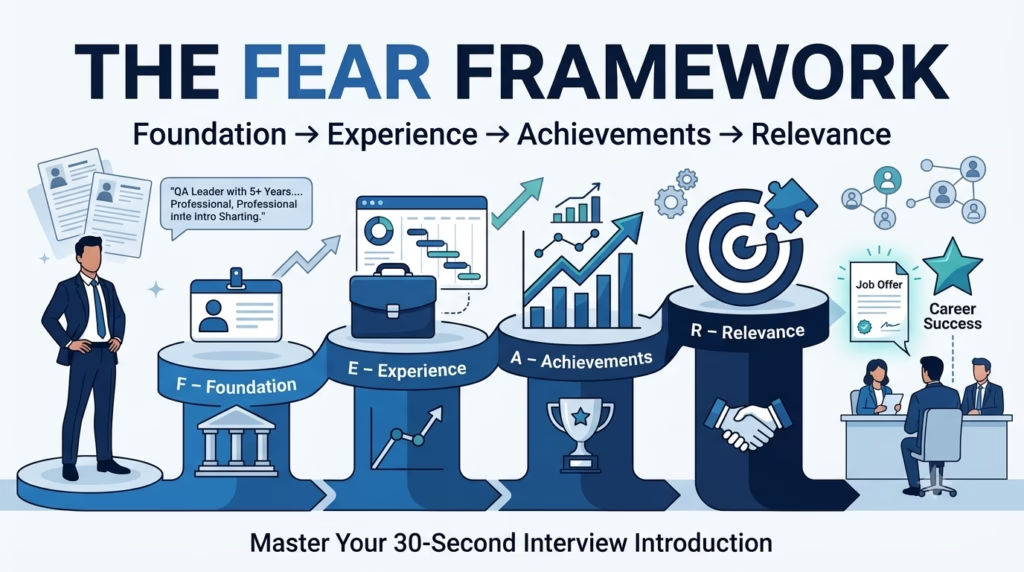
The FEAR Framework is a simple four-step structure for answering “Tell me about yourself” in interviews.
FEAR stands for:
- F → Foundation
- E → Experience
- A → Achievements
- R → Relevance
Instead of randomly talking about your background, the framework helps you create a focused 30-second story that tells interviewers:
- Who you are
- What you have done
- What you achieved
- Why you fit the role
The result is a confident, memorable, and professional introduction that immediately positions you as a strong candidate.
Why This Matters
Interviewers rarely ask “Tell me about yourself” because they want your biography.
They ask it because they want answers to four hidden questions:
- Can this person communicate clearly?
- Can this person summarize information?
- Does this person understand their own career journey?
- Is this person relevant to the role?
Research from hiring managers consistently shows that first impressions significantly influence interview outcomes.
While technical skills determine capability, communication often determines opportunity.
For software testers, automation engineers, and SDETs, this becomes even more important because much of the job involves:
- Explaining defects
- Presenting findings
- Collaborating with developers
- Communicating risks
- Influencing release decisions
A great introduction demonstrates those skills immediately.
What Is the FEAR Framework?
FEAR is a structured storytelling framework designed specifically for interview introductions.
Instead of talking randomly, candidates follow a logical flow.
F = Foundation
Start with your professional identity.
Answer:
Who are you professionally?
Examples:
- Software Tester with 5 years of experience
- SDET specializing in automation frameworks
- QA Engineer focused on web and mobile testing
Keep this section short.
The goal is to establish context.
Common Mistake
Many candidates start with:
“My name is John and I am from…”
The interviewer already knows your name.
Start with your professional value instead.
Do you usually start introductions with your name or your profession?
E = Experience
Next, summarize your experience.
Focus on:
- Years of experience
- Industries
- Technologies
- Specializations
Example:
“I have spent the last five years working in fintech and healthcare applications, focusing on manual testing, API validation, and automation using Selenium and Java.”
This immediately tells the interviewer where your expertise lies.
Why It Matters
Experience creates credibility.
It helps interviewers understand your professional environment.
Common Mistake
Listing every project you’ve worked on.
The introduction is not the time for details.
Save those for later questions.
What’s harder to summarize: your experience or your achievements?
A = Achievements
This is where most candidates miss a huge opportunity.
They talk about responsibilities.
Interviewers care about outcomes.
Instead of saying:
“I executed regression tests.”
Say:
“I helped reduce regression execution time by 60% through automation.”
Instead of:
“I worked on API testing.”
Say:
“I designed API validation suites that identified critical production defects before release.”
Achievements create differentiation.
Responsibilities create similarity.
Real-World Observation
After interviewing hundreds of candidates, many hiring managers report that two candidates may have identical technical skills.
The one who communicates achievements typically leaves a stronger impression.
Common Mistake
Talking only about tasks.
Achievements demonstrate impact.
Tasks demonstrate activity.
Do you focus more on responsibilities or results during interviews?
R = Relevance
This is the most overlooked part.
Connect your background to the role you’re applying for.
Example:
“That’s why I was excited about this opportunity because it aligns closely with my experience in automation and quality engineering.”
This creates a bridge between your past and the employer’s future.
Why It Matters
Interviewers want to know:
“Why are you here?”
Relevance answers that question.
Common Mistake
Ending the introduction abruptly.
Always conclude with relevance.
How often do you tailor your introduction for different companies?
FEAR Framework in Action
Example for a Manual Tester
“Hi, I’m a Software Tester with over four years of experience in web and mobile application testing. I’ve worked primarily in banking and e-commerce domains, focusing on functional, regression, and API testing. One achievement I’m particularly proud of is helping reduce production defects by improving test coverage across critical user journeys. I’m now looking for opportunities where I can contribute to larger-scale quality engineering initiatives, which is why this role caught my attention.”
Approximate duration:
25–30 seconds.
Example for an Automation Engineer
“Hi, I’m an Automation Engineer with six years of experience building test automation solutions for enterprise applications. My background includes Selenium, Java, REST API testing, and CI/CD integration. In my current role, I helped reduce regression execution time by nearly 70% through automation initiatives. I’m excited about this opportunity because it aligns with my passion for scalable test automation and quality engineering.”
Example for an SDET
“Hi, I’m an SDET with seven years of experience developing automation frameworks and improving software quality practices. I’ve worked extensively with Java, Selenium, Playwright, API testing, and cloud-based test execution platforms. One achievement I’m proud of is building a framework that reduced maintenance effort by over 40%. I’m particularly interested in this position because it offers the opportunity to work on quality engineering at scale.”
Why FEAR Works Psychologically
The framework aligns with how humans process information.
People naturally understand stories when they follow a sequence:
- Who
- What
- Results
- Future
FEAR follows the same structure.
Foundation → Experience → Achievement → Relevance
This creates clarity.
Clarity creates confidence.
Confidence creates trust.
Common Mistakes When Answering “Tell Me About Yourself”
Turning It Into a Life Story
Interviewers are not looking for your autobiography.
Stay professional.
Reading the Resume
The interviewer already has your resume.
Add context, not repetition.
Speaking for Three Minutes
Long introductions create fatigue.
Aim for 30–45 seconds.
Using Generic Statements
Avoid:
- Hardworking
- Dedicated
- Passionate
- Team player
Show evidence instead.
Forgetting Relevance
Always connect your story to the role.
The Future of Interview Introductions
AI is changing recruitment.
Resume screening is increasingly automated.
Technical assessments are becoming standardized.
Human communication remains a key differentiator.
Candidates who can communicate clearly, concisely, and confidently will continue to stand out.
The ability to summarize your professional story in 30 seconds may become even more valuable as hiring processes become faster and more competitive.
FEAR Framework Cheat Sheet
Foundation
Who are you?
Experience
What have you done?
Achievement
What impact did you create?
Relevance
Why are you a fit?
Remember:
F + E + A + R = Strong First Impression
Conclusion
The best answer to “Tell me about yourself” is not the longest one.
It is the clearest one.
The FEAR Framework helps candidates structure their introduction around:
- Professional identity
- Relevant experience
- Meaningful achievements
- Role alignment
Whether you’re a Manual Tester, Automation Engineer, SDET, QA Lead, or Quality Engineer, mastering this framework can dramatically improve the first impression you make during interviews.
The next time someone asks:
“Tell me about yourself.”
Don’t tell your life story.
Tell your professional story.
Using FEAR.
Community Discussion
Have you ever lost an interview because of a weak introduction?
Or have you seen a candidate make an unforgettable first impression?
Share your experience in the comments.
Your story might help another tester land their next opportunity.
Was this article helpful?

He’s a builder of communities, a collector of questions, and a relentless challenger of assumptions. While others chase answers, he chases better questions. While others talk about the future of testing, he quietly helps create it.
Join the QABash community
Answer challenges, earn XP, grow your testing career.
Related articles
Tester to SDET: A Career Transition Roadmap
Navigating the Next Phase of Quality Engineering For many years, software testing was largely associated with…
5 min
The 3-P Framework for a Sustainable Testing Career
Have you heard of any secret formula for a Successful Software Testing Career? The software testing industry…
5 min
Discussion
Start the conversation
What do you think about this article? Share your experience, ask a question, or add to the discussion.