Newsletter
One email. Every week. Pure signal.
The week in quality engineering — skip an issue, and you'll wish you hadn't.
20K+ engineers already reading
HTTP QUERY Method (RFC 10008): What It Is and How to Test It

Oct 16, 2026
The HTTP QUERY method, published as RFC 10008 in June 2026, is a safe and idempotent request method that sends its parameters in the request body. It works like a GET with a body: responses can be cached (with the body as part of the cache key) and requests can be retried, which makes it ideal for complex searches that are too large or too sensitive for a URL. Servers advertise support with the Accept-Query header.
For years, API teams have faced the same awkward choice. A search with twenty filters does not fit nicely in a URL, so you either cram it into a giant query string with GET, or you send it as a body with POST and lose everything that makes reads easy: caching, safe retries, and the clear signal that nothing on the server changes.
The HTTP QUERY method fixes that. The IETF published it as RFC 10008 in June 2026, the first new standard HTTP method since PATCH in 2010. This guide explains what QUERY is, how it differs from GET and POST, and, because this is QA Bash, exactly how to test an API that adopts it.
What is the HTTP QUERY method?
QUERY is a request method for read-only operations that carry a body. Like GET, it is safe (it must not change server state), idempotent (sending it twice has the same effect as once) and its responses can be cached. Like POST, the details of the request travel in the body instead of the URL.
QUERY /orders HTTP/1.1
Host: api.example.org
Content-Type: application/json
Accept: application/json

{ "select": ["id", "email", "total"], "status": ["paid", "refunded"], "limit": 10 }
The server reads the body, runs the query, and returns the matching results. Nothing is created, updated or deleted.
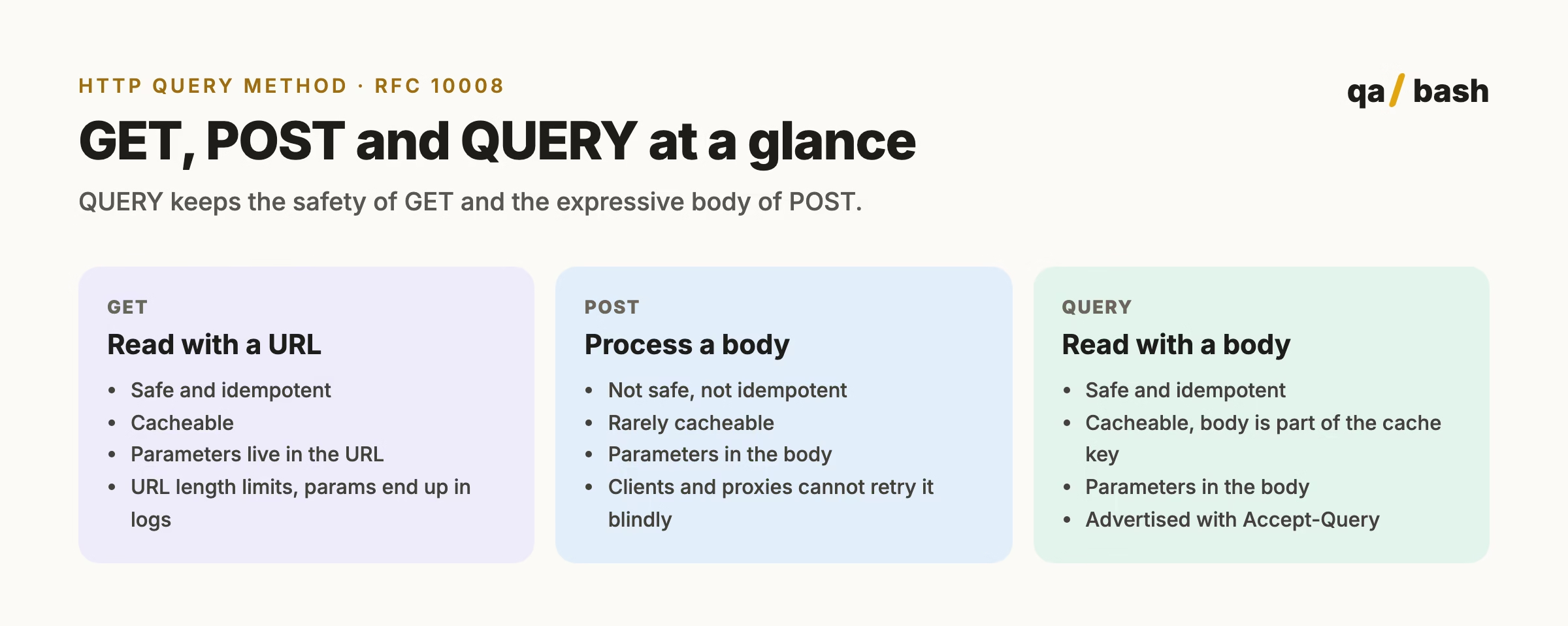
QUERY vs GET vs POST
| Property | GET | POST | QUERY |
|---|---|---|---|
| Safe (no state change) | Yes | No | Yes |
| Idempotent (safe to retry) | Yes | No | Yes |
| Request body | No defined meaning | Yes | Yes |
| Cacheable | Yes | Only in narrow cases | Yes, keyed on the body as well |
| Parameter size | Limited by URL length | Large | Large |
| Parameters visible in URLs and access logs | Yes | No | No |
| Typical use | Fetch a resource | Create or trigger an action | Search, filter, report, complex read |
The practical wins: complex searches no longer hit URL length limits, sensitive filter values stop leaking into access logs and browser history, and infrastructure can treat the request as a read, so it can cache it and retry it after a network failure.
How a server advertises and answers QUERY
RFC 10008 adds a few details worth knowing before you write tests:
- Accept-Query: a new response header in which a server lists the media types it accepts as QUERY bodies, for example
Accept-Query: application/json, application/sql. It tells clients the method is supported on that resource. - The body defines the query: the request’s
Content-Typesays how to interpret it. An unsupported type should be rejected, typically with 415 Unsupported Media Type. - Caching includes the body: a cache may store QUERY responses, but the cache key must take the request content into account, otherwise two different searches could share one cached answer.
- Locations for results: a server can point to a URI where the same results (or the query itself) can be fetched later with a plain GET, using the
LocationorContent-Locationresponse headers. That makes results bookmarkable and shareable.
Is QUERY supported yet?
The standard is new, so support is uneven. As of October 2026, the Rust http crate has merged support, while ASP.NET Core, Axum, Quarkus and the Bruno API client are tracking it in public issues. Any client that lets you set a custom method can already send QUERY, including curl, Python requests, Playwright and REST Assured.
The weak spot is everything in between. Older proxies, load balancers, API gateways and web application firewalls may reject or mishandle a method they do not recognise. That is exactly where testers earn their keep.
How to test an API that uses QUERY
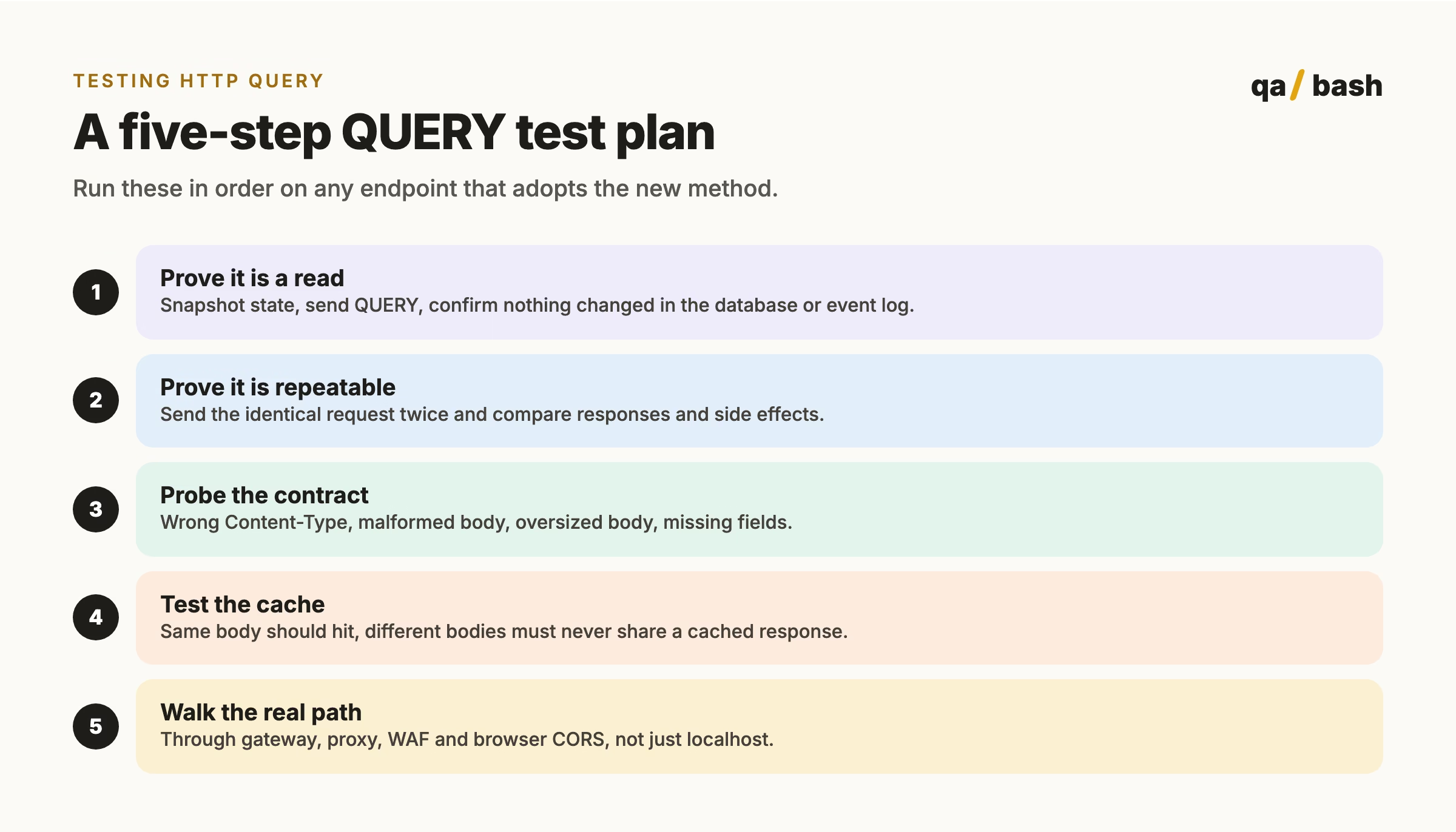
A QUERY endpoint needs every test you would write for a search API, plus checks for the guarantees the method promises. Here is the test matrix we recommend.
| Test | Expected result | Why it matters |
|---|---|---|
| Valid QUERY with a supported Content-Type | 200 with the matching results | Basic correctness |
| Same QUERY sent twice | Identical results, no extra writes | Idempotency is a promise, not a hope |
| Compare database or event log before and after | No change | QUERY must be safe |
| Unsupported Content-Type | 415 Unsupported Media Type | Body format is negotiated |
| Malformed body | 400 with a useful error | Input validation |
| Very large body | Handled, or 413 Content Too Large | Limits move from the URL to the body |
| OPTIONS or a probe request | Accept-Query header present where supported | Clients discover support this way |
| Two different bodies to the same URL through a cache | Different responses | Cache key must include the body |
| Same body through a cache | Cache hit where configured | Caching actually works |
| Request through the real gateway, proxy and WAF | Reaches the service unchanged | Infrastructure may block unknown methods |
| Browser call from another origin | CORS preflight allows QUERY | QUERY is not a CORS-safelisted method |
| Check access logs | Filter values are not logged | A key privacy benefit over GET |
Sending QUERY requests from your test tools
curl
curl -i -X QUERY https://api.example.org/orders
  -H "Content-Type: application/json"
  -d '{"status": ["paid"], "limit": 10}'
Python (requests and pytest)
import requests

def test_query_is_idempotent():
    body = {"status": ["paid"], "limit": 10}
    first = requests.request("QUERY", "https://api.example.org/orders", json=body)
    second = requests.request("QUERY", "https://api.example.org/orders", json=body)
    assert first.status_code == 200
    assert first.json() == second.json()
Playwright (TypeScript)
import { test, expect } from "@playwright/test";

test("QUERY rejects unsupported content types", async ({ request }) => {
  const res = await request.fetch("/orders", {
    method: "QUERY",
    headers: { "Content-Type": "text/plain" },
    data: "status=paid",
  });
  expect(res.status()).toBe(415);
});
REST Assured (Java)
given()
    .contentType(ContentType.JSON)
    .body("{"status": ["paid"], "limit": 10}")
.when()
    .request("QUERY", "/orders")
.then()
    .statusCode(200);
When should a team adopt QUERY?
QUERY is a good fit when a read operation has grown too big or too sensitive for a URL: reporting endpoints, advanced search, analytics filters, or any GET that teams quietly turned into a POST. It is not worth migrating simple lookups like GET /orders/123.
Before switching, check every hop between the client and the service. Run the matrix above through staging with production-like infrastructure, because a gateway that silently drops QUERY is the most likely failure. Keep the old POST search alive until monitoring shows clients have moved.
For more on API test design, see our API testing stories, and practise request-level debugging with the free API Workbench.
Rate this article
8.3/10 average · 34 ratings
Discussion
Start the conversation
What do you think about this article? Share your experience, ask a question, or add to the discussion.

He’s a builder of communities, a collector of questions, and a relentless challenger of assumptions. While others chase answers, he chases better questions. While others talk about the future of testing, he quietly helps create it.
Frequently asked questions.
What is the HTTP QUERY method?
QUERY is an HTTP method for read-only requests that carry a body. It is safe, idempotent and cacheable like GET, but sends its parameters in the request body like POST. It was published as RFC 10008 in June 2026.
Is HTTP QUERY an official standard?
Related articles
Prompt Testing for QA Engineers: How to Build a Prompt Regression Suite
Prompt testing catches regressions when prompts or models change. Learn which assertions to write, how to…
3 min
RAG Testing Framework: How to Test Retrieval-Augmented Generation Systems
This RAG testing framework explains how to test retrieval and generation separately, which metrics to track,…
4 min