500 Skills, Zero Fine-Tuning: LinkedIn's Playbook for AI Agents — Ajay Prakash, LinkedIn

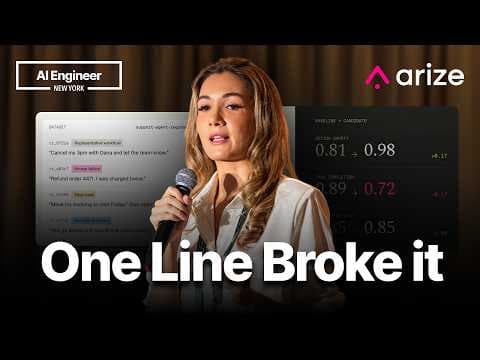
LinkedIn exposes roughly 1,300 tools and 600 playbooks to its coding agents, and all of them sit behind exactly three. MCP degrades somewhere past thirty or forty tools, so Ajay Prakash's team replaced the whole surface with search, get schema, and execute, letting an agent find what it needs instead of carrying everything in context. Prakash is a senior staff software engineer at LinkedIn, and he opens with an on call incident. An alert goes to a coding agent, which pulls the debugging instructions for that specific service, fetches logs and metrics, finds the root cause, proposes mitigation steps, applies them once a human confirms, updates the incident record, and opens a PR for the underlying fix. Minutes instead of hours. The rest of the talk is about the infrastructure that makes that reliable rather than lucky. It did not start there. Agents trained on public repositories knew nothing about a thousand internal repos, custom databases, or a configuration system that new hires spend a week long boot camp learning, so engineers spent longer correcting hallucinations than writing the code themselves. An internal MCP server with code search helped, then documents, Jira, Slack, and feature flags. Tools alone still fell short, because the knowledge of how to use them sat scattered across stale wikis and old Slack threads, and every session started from nothing. Playbooks are the answer: instructions published as tools, invoked like any other tool, kept self contained and split into small referenced pieces so context arrives progressively. Agents are asked to open a PR improving any playbook they find stale, which is what keeps the corpus alive. Speaker info: - https://x.com/ajay_prakash_ai - https://www.linkedin.com/in/ajay-prakash-3780b132/ Timestamps: 0:00 - An on call incident, handled end to end 2:48 - Why coding agents failed inside LinkedIn 5:10 - A thousand repos on internal frameworks 6:34 - An internal MCP, starting with code search 8:30 - Why tools alone were not enough 10:34 - Playbooks, instructions served as tools 12:27 - Two rules, self contained and broken up 14:23 - The loop that keeps playbooks fresh 15:34 - Architecture, local and central playbooks 17:23 - Three meta tools to scale past the MCP limit 19:01 - Takeaways
Join the discussion
Sign in to join the discussion
Sign in