AI Roadmap for Testers: From Beginner to AI-Powered Quality Engineer

Jun 16, 2026
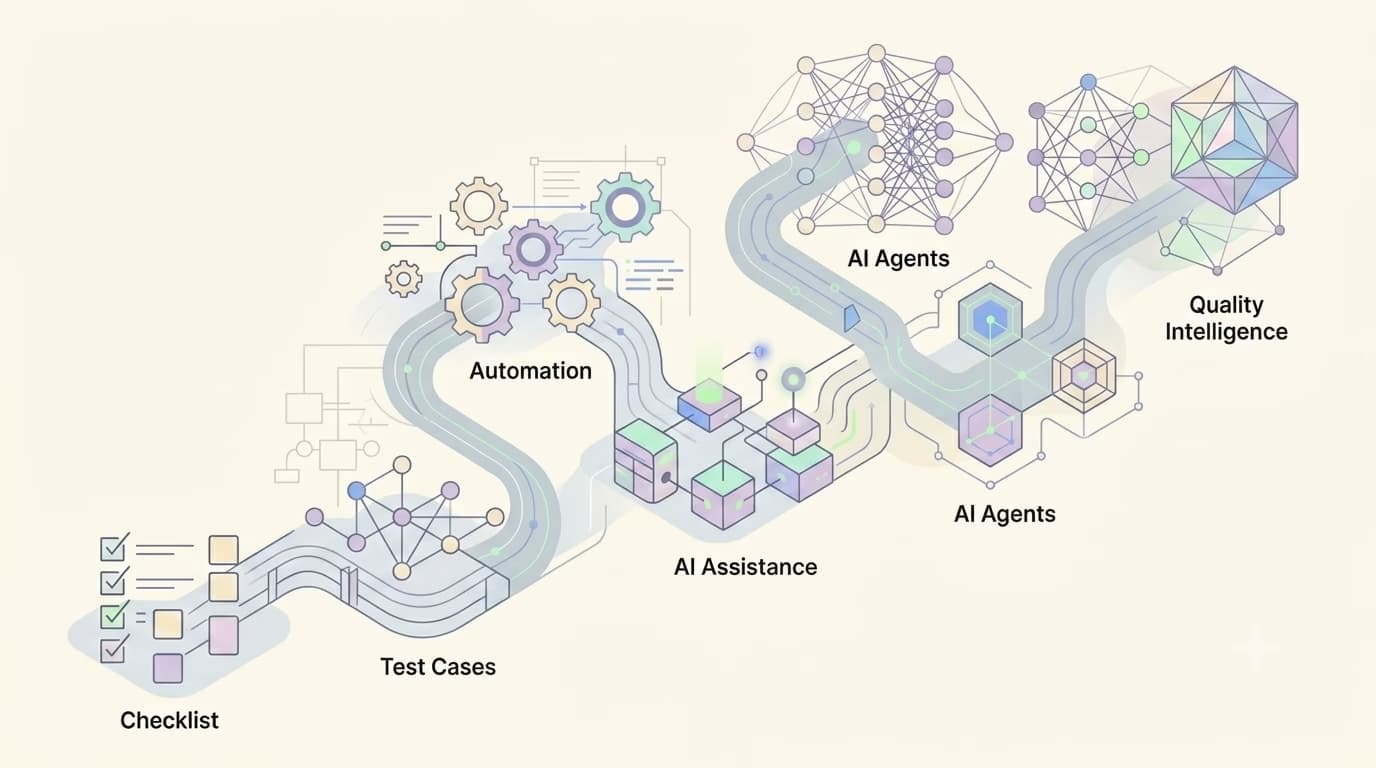
A Hard Truth Most Testers Don’t Want to Hear
One pattern I repeatedly see across testing communities is that many testers are worrying about the wrong thing.
The fear is usually framed as:
“Will AI replace software testers?”
After spending the last couple of months experimenting with AI tools, reviewing AI-generated test cases, evaluating AI testing products, and observing how engineering teams are adopting AI, I believe that question misses the real shift happening around us.
The bigger question is:
Will testers who understand AI outperform testers who don’t?
The answer is already becoming visible.
Teams are using AI to generate test ideas, analyze requirements, summarize defects, review pull requests, optimize regression suites, and even assist with release readiness discussions.
Yet despite this adoption, many testers are approaching AI in an unstructured way. They watch random videos, experiment with prompts, try a few tools, and then wonder why the results feel inconsistent.
The challenge isn’t access to AI.
The challenge is building a systematic understanding of how AI works, where it helps, where it fails, and how it fits into modern quality engineering.
This roadmap is designed to solve that problem.
It focuses on practical skills, realistic expectations, and capabilities that will remain valuable long after the latest AI tool is replaced by another.
Quick Answer
An AI roadmap for testers is a structured learning path that helps QA professionals understand AI concepts, apply AI to daily testing activities, build technical foundations, and prepare for the future of quality engineering.
The most effective roadmap follows five stages:
- Learn AI fundamentals before learning tools
- Master prompt engineering and AI-assisted testing workflows
- Apply AI to real QA activities such as requirement analysis and regression optimization
- Strengthen technical skills including Python, APIs, Git, and automation
- Understand modern AI systems such as RAG, AI Agents, and LLM evaluation
The goal is not to become a machine learning engineer.
The goal is to become a stronger tester who can leverage AI effectively while understanding its strengths, limitations, and risks.
Why This Matters
Several years ago, automation became the dividing line between traditional testing and modern testing.
Today, AI is creating a similar shift.
That does not mean manual testing is disappearing.
It means expectations are changing.
A tester who can:
- Analyze requirements using AI
- Generate high-quality test scenarios
- Review AI-generated outputs
- Validate AI systems
- Use AI to accelerate exploratory testing
can often deliver significantly more value than someone performing the same work manually.
At the same time, there is a danger.
Many organizations are treating AI as a productivity tool without understanding its failure modes.
Production incidents often reveal something interesting:
The AI generated a perfectly reasonable answer.
It just wasn’t the correct answer.
That distinction matters.
Quality professionals are uniquely positioned to bridge this gap because testing has always been about critical thinking, risk analysis, and validation.
Those skills are becoming more important, not less.
AI rewards testers who can think critically. It punishes testers who accept outputs without verification.
Phase 1: AI Foundations for Testers (Weeks 1-2)
What It Is
The first phase focuses on understanding AI before attempting to use it professionally.
Many testers jump directly into prompts.
That sounds efficient.
In practice, it often creates confusion because they lack the mental models needed to understand why AI behaves the way it does.
This phase covers:
- Artificial Intelligence
- Machine Learning
- Deep Learning
- Generative AI
- Large Language Models
- Tokens
- Context Windows
- Hallucinations
- AI limitations
- AI use cases in testing
Why It Matters
In many teams I have worked with, unrealistic expectations cause more problems than technical limitations.
Some teams assume AI is intelligent.
Others assume AI is useless.
Neither position is accurate.
Understanding AI fundamentals helps testers:
- Evaluate AI-generated outputs
- Challenge incorrect responses
- Understand confidence levels
- Detect hallucinations
- Make informed adoption decisions
Without these foundations, AI becomes a black box.
Testing professionals should never be comfortable with black boxes.
How It Works
Module 1: What Is Artificial Intelligence?
Focus Areas:
- Narrow AI
- General AI
- Rule-Based Systems
- AI-Assisted Decision Systems
Practical Testing Example:
A recommendation engine suggesting products is an AI application.
A simple validation rule checking mandatory fields is not.
Understanding this distinction helps testers design more effective test strategies.
Module 2: Machine Learning Fundamentals
Focus Areas:
- Training
- Inference
- Data Quality
- Model Performance
Testing Perspective:
Machine learning systems behave differently from traditional software.
Traditional systems follow explicit rules.
Machine learning systems learn patterns.
This creates unique testing challenges.
Module 3: Deep Learning
Focus Areas:
- Neural Networks
- Pattern Recognition
- Feature Learning
The goal is not mathematical mastery.
The goal is understanding why modern AI became capable of generating text, code, and images.
Module 4: Generative AI
Focus Areas:
- Text Generation
- Code Generation
- Image Generation
- Content Creation
Tester Perspective:
Generative AI can create:
- Test cases
- Test data
- Bug reports
- Automation scripts
It can also create incorrect outputs that appear convincing.
Module 5: How ChatGPT Works
Focus Areas:
- Transformers
- Token Prediction
- Context
- Probability
Common Misconception:
Many people believe ChatGPT retrieves answers from a database.
It doesn’t.
It predicts likely next tokens based on patterns learned during training.
Understanding this single concept explains many AI limitations.
Module 6: Tokens, Context Windows and Temperature
| Concept | Why Testers Should Care |
|---|---|
| Tokens | Determines input size limits |
| Context Window | Impacts memory within conversations |
| Temperature | Impacts creativity and consistency |
| Prompt Length | Affects output quality |
Module 7: Hallucinations and Limitations
Hallucinations are not bugs.
They are a natural outcome of probabilistic generation.
Understanding this changes how testers evaluate AI systems.
A testing strategy for AI systems must include:
- Accuracy validation
- Fact checking
- Edge case analysis
- Prompt robustness testing
Real-World Application
A large enterprise team recently introduced AI-assisted requirement analysis.
Initially the team reported substantial productivity gains.
After several sprints they discovered something interesting.
The AI generated excellent happy-path scenarios.
However, many risk-based scenarios were missing.
Critical negative paths remained uncovered.
The lesson was simple.
AI accelerated thinking.
It did not replace thinking.
That distinction appears repeatedly in successful AI adoption programs.
Common Mistakes
Mistake 1: Learning Tools Before Concepts
Warning Sign: Tool hopping every week.
Metric: No repeatable workflow after thirty days.
Mistake 2: Treating AI as an Authority
Warning Sign: Outputs accepted without verification.
Metric: Defect leakage from AI-generated artifacts.
Mistake 3: Ignoring Hallucinations
Warning Sign: Blind trust in generated answers.
Metric: Incorrect requirements, tests, or automation artifacts entering production.
Best Practices
- Spend at least two weeks understanding fundamentals
- Compare outputs across multiple LLMs
- Intentionally test hallucination scenarios
- Learn how context windows impact responses
- Validate every AI-generated artifact
- Build a habit of evidence-based verification
Future Outlook
Next 12 Months
More AI functionality will become embedded inside testing tools.
The challenge will shift from “How do I use AI?” to “How do I evaluate AI outputs?”
Next 24 Months
AI literacy may become as important for testers as automation literacy became over the previous decade.
Organizations are increasingly seeking testers who understand both quality engineering and AI systems.
Should every software tester understand how LLMs work, or is practical tool usage sufficient?
AI → ML → Deep Learning → Generative AI → LLMs
The biggest risk in AI adoption is not hallucination. It is false confidence in hallucinated outputs.
Phase 2: Prompt Engineering for Testers (Weeks 3-4)
What It Is
Prompt engineering is the skill of communicating effectively with AI systems.
Many people treat prompts as questions.
Experienced users treat prompts as specifications.
The quality of the output is heavily influenced by the quality of the instruction.
For testers, prompt engineering is becoming a practical productivity skill.
It can influence:
- Requirement analysis
- Test design
- Exploratory testing
- Defect reporting
- Automation development
Why It Matters
A mistake many automation teams make is assuming AI quality depends entirely on the model.
In reality, prompt quality often matters just as much.
The difference between:
“Generate test cases”
and
“Act as a senior QA architect. Generate high-risk functional, negative, boundary, integration, and security test scenarios for this requirement.”
is significant.
One prompt generates content.
The other generates context-aware testing artifacts.
How It Works
Module 11: Introduction to Prompt Engineering
Core Concepts:
- Instructions
- Context
- Constraints
- Output Formats
Think of prompts as requirements for AI.
Poor requirements create poor outputs.
The same principle applies here.
Module 12: Zero-Shot vs Few-Shot Prompting
| Approach | Description | Best Use Case |
|---|---|---|
| Zero-Shot | No examples provided | Simple tasks |
| Few-Shot | Examples included | Complex testing tasks |
Decision Framework:
| Scenario | Recommended Approach |
|---|---|
| Simple test case generation | Zero-Shot |
| Domain-heavy applications | Few-Shot |
| Regulatory systems | Few-Shot |
| Healthcare applications | Few-Shot |
| Financial workflows | Few-Shot |
Module 13: Role-Based Prompting
Examples:
- Act as a Senior QA Lead
- Act as a Security Tester
- Act as a Product Owner
- Act as a Performance Engineer
Role-based prompting often improves context awareness.
However, it is not magic.
Domain information remains critical.
Module 14: Chain-of-Thought Prompting
Focus Areas:
- Structured Reasoning
- Risk Analysis
- Scenario Expansion
Practical Example:
Instead of asking for test cases directly:
- Analyze requirements
- Identify risks
- Identify integrations
- Generate scenarios
- Prioritize tests
This often produces stronger results.
Module 15: AI-Powered Requirement Analysis
Workflow:
Requirement → Risk Identification → Missing Requirements → Clarification Questions → Test Scenarios
One pattern I repeatedly see is that AI is surprisingly effective at identifying missing requirement details.
This makes it valuable during refinement sessions.
Module 16: AI-Powered Test Case Generation
Strengths:
- Speed
- Coverage ideas
- Edge case suggestions
Weaknesses:
- Context gaps
- Domain misunderstandings
- Risk blind spots
AI-generated test cases should be reviewed exactly like code reviews.
Module 17: Test Data Generation
AI can generate:
- Boundary values
- Invalid inputs
- Localization datasets
- API payloads
Common Mistake:
Using generated data without validating business rules.
Module 18: AI-Assisted Bug Reporting
AI can help improve:
- Reproduction steps
- Impact analysis
- Root cause hypotheses
- Communication quality
However:
The tester remains accountable for correctness.
Module 19: Exploratory Testing with AI
This is one of the most underrated use cases.
AI can suggest:
- Testing heuristics
- Risk areas
- User personas
- Negative paths
The human tester still performs exploration.
AI simply expands thinking.
Module 20: Building a Personal Prompt Library
Recommended Categories:
- Requirement Analysis
- Test Design
- API Testing
- Defect Analysis
- Exploratory Testing
- Automation Reviews
- Release Readiness
Over time, prompt libraries become organizational assets.
Real-World Application
During a Playwright migration effort, a team used AI to review hundreds of legacy Selenium tests.
The AI successfully identified duplicated logic, naming inconsistencies, and outdated assertions.
What surprised me most was not the code generation.
It was the code review capability.
The productivity gain came from analysis rather than automation generation.
Common Mistakes
Mistake 1: Using Generic Prompts
Warning Sign: Generic outputs.
Metric: High review effort.
Mistake 2: Expecting One Prompt to Solve Everything
Warning Sign: Huge prompts attempting multiple tasks.
Metric: Inconsistent results.
Mistake 3: Skipping Human Review
Warning Sign: Generated artifacts entering repositories unchanged.
Metric: Defect leakage and maintenance debt.
Best Practices
- Build reusable prompt templates
- Use role-based prompting
- Break large tasks into smaller tasks
- Verify generated outputs
- Create domain-specific examples
- Maintain a team prompt repository
Future Outlook
Next 12 Months
Prompt engineering will increasingly become embedded inside testing platforms.
Next 24 Months
The skill will evolve from writing prompts to designing AI-assisted workflows.
Testers who understand workflow orchestration will gain a significant advantage.
Do you believe prompt engineering will become a core QA skill, or will future AI systems make prompting largely unnecessary?
Requirement → Context → Prompt → AI Output → Human Validation.
The quality of AI output is often a reflection of the quality of the context you provide.
AI-generated test cases should be reviewed with the same skepticism applied to developer-written code.
Phase 3: AI-Powered Quality Engineering (Weeks 5-6)
What It Is
Most testers stop at prompt engineering.
That is useful, but it is only the beginning.
The real value appears when AI becomes part of daily quality workflows.
This phase focuses on applying AI to actual testing activities rather than treating it as a standalone tool.
The objective is simple:
Move from “using AI occasionally” to “embedding AI into quality engineering processes.”
This is where testers begin seeing measurable productivity improvements.
Not because AI replaces testing.
Because AI helps testers spend less time on repetitive activities and more time on risk analysis, investigation, and decision-making.
Why It Matters
During release cycles, time is almost always the scarcest resource.
Requirements change.
Deadlines remain fixed.
Regression suites continue growing.
Test data becomes outdated.
Environments become unstable.
The real bottleneck is rarely test execution.
The bottleneck is often analysis.
Teams spend enormous amounts of time:
- Understanding requirements
- Identifying risks
- Reviewing defects
- Prioritizing tests
- Assessing release readiness
These activities are where AI can provide significant assistance.
Not by making decisions.
By accelerating the preparation needed to make decisions.
The future of testing is not AI replacing testers. It is AI reducing the time spent on low-leverage work.
How It Works
Module 21: AI for Requirement Analysis
Workflow:
Requirement →Requirement Review → Gap Analysis → Risk Identification → Test Scenario Generation
AI can identify:
- Missing acceptance criteria
- Ambiguous requirements
- Potential edge cases
- Hidden dependencies
Practical Example:
A payment workflow mentions successful transactions but ignores:
- Partial failures
- Network interruptions
- Retry logic
- Timeout handling
AI often surfaces these omissions quickly.
Module 22: AI for Risk-Based Testing
Traditional risk analysis often depends on individual experience.
AI can help standardize risk discovery.
Inputs:
- Requirements
- Architecture diagrams
- Incident history
- Production defects
Outputs:
- High-risk modules
- Integration risks
- Security concerns
- Performance concerns
Decision Framework:
| Risk Level | Recommended Testing Depth |
|---|---|
| Critical | Full regression + exploratory testing |
| High | Extensive functional and integration testing |
| Medium | Targeted regression |
| Low | Smoke validation |
Important:
AI identifies possibilities.
Humans determine priorities.
Module 23: AI for Test Case Reviews
Most organizations review code.
Very few review test cases rigorously.
AI can assist by evaluating:
- Coverage gaps
- Duplicate scenarios
- Missing negative tests
- Missing boundary validations
Common Observation:
Many generated test suites contain excessive happy-path coverage and insufficient risk coverage.
Module 24: AI for Regression Optimization
One pattern I repeatedly see is regression suites growing faster than teams can maintain them.
A suite that once ran in 20 minutes suddenly requires 6 hours.
AI can assist with:
- Impact analysis
- Change analysis
- Test selection
- Redundant test identification
Important:
Optimization should reduce redundancy, not reduce confidence.
Debate
Run Every Regression Test
vs
Run Only Impacted Tests
Both approaches have advantages.
The correct choice depends on:
- Release frequency
- Risk tolerance
- Test reliability
- Production exposure
Module 25: AI for Defect Analysis
AI can help classify:
- Duplicate defects
- Defect categories
- Root cause patterns
- Incident trends
Practical Dashboard Metrics:
| Metric | Why It Matters |
|---|---|
| Defect Leakage | Production quality indicator |
| Reopen Rate | Defect quality indicator |
| Duplicate Defects | Triage efficiency indicator |
| Escaped Critical Defects | Release risk indicator |
Module 26: AI for Root Cause Analysis
Production incidents often reveal something surprising.
The visible defect is rarely the real problem.
AI can help connect:
- Logs
- Deployment history
- Recent code changes
- Historical incidents
However:
Root cause analysis remains a human-led activity.
Context and judgment remain essential.
Module 27: AI for API Testing
API testing is one of the strongest AI use cases available today.
AI can generate:
- Payload variations
- Edge-case inputs
- Contract validation ideas
- Authentication scenarios
Pro Tip:
Use AI to expand API coverage ideas, not to replace API understanding.
Module 28: AI for SQL Query Generation
Many testers spend years working with databases but remain uncomfortable writing SQL.
AI can help create:
- Joins
- Validation queries
- Aggregation queries
- Data verification queries
Common Mistake:
Executing generated SQL directly against production-like environments without review.
Always validate logic first.
Module 29: AI for Release Readiness Reviews
Release readiness discussions often become subjective.
AI can help aggregate signals.
Example Inputs:
- Open defects
- Test execution results
- Production incidents
- Code churn
- Deployment history
Potential Outputs:
- Risk summary
- Concern areas
- Suggested validations
The final release decision must remain human-owned.
Module 30: AI Tools Every Tester Should Know
| Tool | Primary Strength |
|---|---|
| ChatGPT | General-purpose QA assistance |
| Claude | Long-context analysis |
| Gemini | Workspace integration |
| Perplexity | Research and discovery |
| NotebookLM | Document analysis |
| GitHub Copilot | Developer assistance |
| Cursor | AI-assisted coding |
| Windsurf | Workflow acceleration |
Common Assumption to Challenge:
Using more AI tools does not automatically increase productivity.
A well-defined workflow often matters more than tool quantity.
Real-World Application
A large SaaS platform experienced a recurring production issue involving subscription renewals.
The defect appeared only under specific timing conditions involving retries and delayed payment callbacks.
Traditional regression suites consistently passed.
AI-assisted requirement analysis identified a previously overlooked race condition scenario.
The defect had existed for months.
The problem was not automation coverage.
The problem was missing test ideas.
This is where AI often provides its greatest value.
Not execution.
Idea generation.
Common Mistakes
Mistake 1: Treating AI as a Decision Maker
Warning Sign: Release decisions made solely from AI recommendations.
Metric: Increase in escaped defects.
Mistake 2: Optimizing Regression Suites Aggressively
Warning Sign: Rapid reduction in suite size.
Metric: Growing defect leakage.
Mistake 3: Blindly Trusting Generated SQL
Warning Sign: Queries executed without validation.
Metric: Incorrect data verification.
Mistake 4: Measuring AI Success Using Time Saved Alone
Warning Sign: Productivity celebrated despite quality decline.
Metric: Increased rework.
Best Practices
- Use AI to support decisions, not replace them
- Validate generated outputs
- Build review checkpoints
- Track quality outcomes
- Measure defect leakage after AI adoption
- Maintain human accountability
Future Outlook
Next 12 Months
AI-assisted requirement analysis and test design will become common across enterprise teams.
Next 24 Months
Many quality platforms will include built-in risk analysis, defect clustering, and regression optimization capabilities.
The differentiator will not be access to AI.
The differentiator will be the ability to evaluate AI-generated recommendations.
Would you allow AI-generated risk assessments to influence release go/no-go decisions?
AI is often better at finding possibilities than determining priorities.
The quality risk is rarely where teams think it is. AI can help expose blind spots, but humans must decide what matters.
Phase 4: Technical Foundations for Modern Testers (Weeks 7-8)
What It Is
AI is changing testing.
It is not changing the importance of technical skills.
In fact, one of the most surprising trends I have observed is that AI often amplifies technical capability rather than replacing it.
Strong testers become stronger.
Weak technical foundations become more visible.
This phase focuses on the technical skills that continue to provide leverage regardless of tooling trends.
Why It Matters
A common misconception is that testers no longer need programming skills because AI can generate automation scripts.
This sounds attractive.
It also breaks quickly in real projects.
AI can generate code.
Someone still needs to:
- Review it
- Debug it
- Maintain it
- Improve it
- Integrate it
Production systems are complex.
Generated scripts rarely survive unchanged.
Technical depth remains essential.
Assumption to Challenge
AI-generated automation reduces the need for programming skills.
Reality:
AI increases the value of programming skills because more generated code must be reviewed and maintained.
How It Works
Module 31: Why Testers Should Learn Programming
Programming provides:
- Problem-solving skills
- Automation capability
- Better debugging
- Improved collaboration with developers
The goal is not becoming a software engineer.
The goal is becoming technically effective.
Module 32: Python Fundamentals
Recommended Topics:
- Variables
- Data Types
- Functions
- Loops
- Lists
- Dictionaries
- Exception Handling
Practical QA Applications:
- Test data generation
- API validation
- Log analysis
- Reporting
Decision Framework:
| Skill | Priority |
|---|---|
| Variables and Functions | High |
| Loops and Collections | High |
| OOP Concepts | Medium |
| Advanced Design Patterns | Low Initially |
Module 33: Git Fundamentals
Every tester working in modern engineering teams should understand:
- Commits
- Branches
- Pull Requests
- Merge Conflicts
Common Mistake:
Treating Git as a developer-only tool.
Version control is a quality engineering skill.
Module 34: API Testing Fundamentals
One pattern I repeatedly see is teams investing heavily in UI automation while neglecting API validation.
API tests often provide:
- Faster feedback
- Better reliability
- Lower maintenance costs
Comparison Table:
| Testing Layer | Speed | Stability | Maintenance |
|---|---|---|---|
| UI | Slow | Lower | High |
| API | Fast | High | Medium |
| Unit | Very Fast | Very High | Low |
Debate
Should teams automate UI-first?
vs
Should teams automate API-first?
Most mature teams eventually prioritize API coverage.
Module 35: Playwright Fundamentals
Recommended Topics:
- Locators
- Assertions
- Fixtures
- Parallel Execution
- Reporting
Why Playwright?
Many teams are moving toward Playwright because of:
- Stability improvements
- Modern architecture
- Better developer experience
That does not mean Selenium is obsolete.
Context matters.
Large Selenium ecosystems remain common.
Comparison
| Criteria | Selenium | Playwright |
|---|---|---|
| Ecosystem | Very Large | Growing Rapidly |
| Setup Complexity | Moderate | Lower |
| Parallel Execution | Supported | Strong |
| Auto-Waits | Limited | Strong |
| Learning Curve | Moderate | Moderate |
Module 36: Using AI to Build Automation Faster
Practical Uses:
- Locator generation
- Script scaffolding
- Debugging assistance
- Refactoring support
- Framework documentation
Common Mistake:
Accepting generated automation without understanding it.
Every line of generated code becomes future maintenance responsibility.
Real-World Application
A team migrated hundreds of Selenium tests to Playwright using AI-assisted code conversion.
Initial productivity looked impressive.
However, nearly 30% of generated scripts required significant rework due to framework-specific assumptions.
The lesson:
AI accelerated migration.
It did not eliminate engineering review.
Successful adoption depended on experienced automation engineers validating outputs.
Common Mistakes
Mistake 1: Learning AI Before Learning Testing Fundamentals
Warning Sign: Heavy prompt usage but weak testing judgment.
Metric: Poor defect discovery.
Mistake 2: Ignoring APIs
Warning Sign: Overdependence on UI automation.
Metric: Long execution times.
Mistake 3: Blindly Accepting Generated Code
Warning Sign: Increasing flaky automation.
Metric: Growing maintenance effort.
Mistake 4: Avoiding Version Control
Warning Sign: Manual sharing of automation code.
Metric: Collaboration friction.
Best Practices
- Learn one programming language well
- Prioritize API testing skills
- Use Git daily
- Understand automation architecture
- Review every AI-generated script
- Focus on maintainability over speed
Future Outlook
Next 12 Months
AI-assisted coding will become a standard feature across automation tooling.
Next 24 Months
The most valuable automation engineers will combine:
- Testing expertise
- Programming ability
- AI workflow knowledge
The market will increasingly reward this combination.
If AI can generate automation scripts instantly, should programming still be considered a mandatory skill for testers?
AI can generate code. It cannot own the consequences of that code.
Strong testing judgment becomes more valuable, not less, in an AI-assisted world.
Phase 5: AI Engineering Concepts (Weeks 9-10)
What It Is
Most testers will stop after learning prompts, AI tools, and AI-assisted testing.
That is perfectly fine for many roles.
However, the next wave of opportunities is emerging around testing AI systems themselves.
This phase focuses on understanding how modern AI applications are built.
The goal is not becoming a machine learning engineer.
The goal is understanding enough about AI architecture to participate in design reviews, testing strategies, risk assessments, and AI quality initiatives.
In many teams I have worked with, testers who understand system architecture become disproportionately valuable.
The same pattern is beginning to emerge with AI systems.
Why It Matters
Many organizations are deploying:
- AI Assistants
- Customer Support Bots
- Knowledge Retrieval Systems
- AI Copilots
- Agentic Workflows
These systems introduce risks that traditional testing approaches do not fully address.
Examples:
- Hallucinations
- Retrieval failures
- Prompt injection attacks
- Context corruption
- Tool execution failures
- Incorrect reasoning
Traditional test cases alone are not enough.
Quality engineers must understand how these systems work internally.
You cannot effectively test a system you fundamentally do not understand.
How It Works
Module 37: What is RAG?
RAG stands for Retrieval-Augmented Generation.
It is one of the most important concepts modern testers should understand.
Instead of relying solely on training data, a RAG system retrieves information from trusted sources before generating a response.
Workflow:
User Question → Document Retrieval → Context Assembly → LLM Processing → Response Generation
Benefits:
- More current information
- Reduced hallucinations
- Enterprise knowledge integration
Practical Testing Scenario:
Testing a banking support chatbot.
Questions:
- Did retrieval find the correct document?
- Was the correct section selected?
- Did the final answer match retrieved content?
- Were sensitive documents exposed?
Module 38: What Are AI Agents?
Agents extend LLMs by allowing them to:
- Plan
- Reason
- Call tools
- Execute actions
- Evaluate outcomes
Traditional Automation:
Input → Execution → Output
Agent Workflow:
Goal → Planning → Tool Usage → Decision → Iteration → Completion
Testing Challenges:
- Tool failures
- Incorrect decisions
- Infinite loops
- Permission violations
We Can Debate
Are AI Agents simply advanced automation?
vs
Are AI Agents fundamentally different systems requiring new testing approaches?
Module 39: MCP (Model Context Protocol)
One of the most important emerging concepts for testers.
MCP provides a standard way for AI systems to interact with external tools and services.
Examples:
- Jira
- GitHub
- Databases
- Test Management Systems
- Documentation Repositories
Why Testers Should Care?
Future AI-powered testing ecosystems will increasingly rely on tool connectivity.
Testing responsibilities may include:
- Tool access validation
- Permission validation
- Data integrity checks
- Security verification
Module 40: How AI Test Case Generators Work
Most AI testing products follow a similar pattern:
Requirement → Prompt Processing → Scenario Extraction → Test Generation → Review Layer
Common Assumption to Challenge:
AI-generated tests are automatically comprehensive.
Reality:
Generated coverage is constrained by:
- Requirement quality
- Context quality
- Prompt quality
- Domain knowledge
Coverage gaps still exist.
Module 41: Evaluating AI Systems
This may become one of the most valuable testing skills of the decade.
Traditional Validation:
Expected Input → Expected Output
AI Validation:
Prompt → Probabilistic Output
Evaluation Areas:
| Area | Validation Focus |
|---|---|
| Accuracy | Correctness |
| Hallucination Rate | False Information |
| Robustness | Adversarial Inputs |
| Consistency | Repeatability |
| Security | Prompt Injection |
| Bias | Fairness Risks |
Testing AI systems requires probabilistic thinking rather than deterministic thinking.
Module 42: AI Testing as a Career Path
Emerging Roles:
- AI QA Engineer
- AI Quality Engineer
- LLM Evaluator
- AI Safety Tester
- AI Validation Specialist
- AI Product Quality Lead
What surprised me most over the last year is how many organizations are searching for people who understand both testing and AI.
Pure AI expertise is valuable.
Pure testing expertise is valuable.
The intersection of both is becoming increasingly rare.
Module 43: Future of AI-Powered Quality Engineering
Over the next few years we will likely see:
- Agentic Testing Workflows
- Autonomous Risk Analysis
- AI-Generated Regression Recommendations
- Quality Intelligence Platforms
- AI-Powered Defect Prevention
However, a critical distinction remains.
Organizations do not pay testers for executing test cases.
Organizations pay testers for reducing risk.
That responsibility remains human.
Real-World Application
Imagine an enterprise support chatbot using RAG and multiple agents.
The system:
- Retrieves documents
- Queries databases
- Creates tickets
- Updates records
A traditional test strategy would validate functionality.
An AI-aware test strategy would additionally validate:
- Retrieval accuracy
- Hallucination resistance
- Tool permissions
- Agent decision quality
- Prompt injection resilience
The second strategy provides significantly better risk coverage.
Common Mistakes
Mistake 1: Treating AI Systems Like Traditional Software
Warning Sign: Only validating functional correctness.
Metric: Missed hallucinations.
Mistake 2: Ignoring Retrieval Validation
Warning Sign: Focus only on generated responses.
Metric: Incorrect knowledge delivery.
Mistake 3: Skipping Security Evaluation
Warning Sign: No prompt injection testing.
Metric: Unauthorized information exposure.
Mistake 4: Measuring Accuracy Alone
Warning Sign: Success defined only by correctness.
Metric: Unstable user experiences.
Best Practices
- Learn RAG fundamentals
- Understand AI agents
- Explore MCP ecosystems
- Test retrieval separately from generation
- Evaluate hallucinations intentionally
- Include security testing in AI strategies
- Develop probabilistic testing mindsets
Future Outlook
Next 12 Months
Organizations will increasingly require testers to evaluate AI-enabled applications.
Next 24 Months
AI quality engineering may become a specialized career track similar to performance testing or security testing.
Should AI system testing become a dedicated specialization within quality engineering?
The hardest part of testing AI is not validating answers. It is validating confidence.
Future QA teams may spend less time validating screens and more time validating decisions.
Final Capstone Project
Build an AI-Powered QA Assistant
The purpose of this project is to combine everything learned throughout the roadmap.
Objectives
Build a QA assistant capable of:
- Requirement Analysis
- Risk Identification
- Test Scenario Generation
- Test Data Generation
- Defect Analysis
- Release Readiness Reviews
Suggested Inputs
- User Stories
- Requirements Documents
- Release Notes
- Defect Reports
- API Specifications
Suggested Outputs
- Risk Reports
- Test Scenarios
- Test Data Sets
- Release Recommendations
- Defect Summaries
Skills Demonstrated
- Prompt Engineering
- AI-Assisted Testing
- Python Fundamentals
- API Knowledge
- AI Evaluation
- Quality Engineering Thinking
This project becomes a portfolio asset that demonstrates practical AI adoption rather than theoretical learning.
End Note
The conversation around AI and testing often becomes emotional.
Some people believe AI will replace testers.
Others dismiss AI entirely.
Both positions miss the opportunity.
Throughout my career, every major shift in testing has followed a similar pattern.
Manual testing did not disappear because automation emerged.
Automation did not disappear because DevOps emerged.
Testing itself did not disappear because Agile emerged.
The profession evolved.
AI represents another evolution.
The testers who thrive will not necessarily be those with the deepest AI expertise.
They will be the testers who combine:
- Critical thinking
- Risk analysis
- Technical depth
- AI literacy
- Business understanding
Those skills together create exceptional quality engineers.
The roadmap in this article is designed to build exactly that combination.
Key Takeaways
- AI literacy is becoming a foundational skill for testers.
- Prompt engineering is useful but not sufficient.
- AI provides the greatest value in analysis and idea generation.
- Technical skills remain essential despite AI-assisted coding.
- Understanding RAG, agents, and MCP creates future opportunities.
- AI systems require new testing approaches.
- Human judgment remains the most important quality control mechanism.
- Quality engineering is becoming more strategic, not less.
Five years from now, what do you think will be the most valuable skill for testers: automation, AI evaluation, domain expertise, or risk analysis?
Frequently Asked Questions
Do testers need to learn machine learning algorithms?
No. Most testers do not need to build machine learning models. However, understanding the basics of training, inference, model limitations, and evaluation helps when testing AI-enabled systems.
Is prompt engineering enough to stay relevant?
Prompt engineering is valuable but should be viewed as an entry point. Long-term value comes from combining AI skills with testing expertise, technical knowledge, and quality engineering practices.
Which AI tool should testers learn first?
Start with one general-purpose LLM such as ChatGPT, Claude, or Gemini. Focus on workflows rather than tool hopping. Understanding how to solve testing problems matters more than mastering multiple interfaces.
Will AI replace manual testing?
AI will automate some repetitive activities, but exploratory testing, risk analysis, stakeholder communication, and quality assessment remain heavily dependent on human judgment.
Is Python mandatory for testers?
Not mandatory for every role, but highly recommended. Python is widely used in automation, API testing, AI workflows, and data analysis.
Should manual testers learn automation before AI?
Ideally, learn both in parallel. AI can accelerate learning automation, while automation skills improve understanding of AI-generated code and workflows.
What is the biggest mistake teams make with AI adoption?
Treating AI outputs as authoritative without verification. Quality declines rapidly when teams stop validating generated artifacts.
Why should testers learn RAG?
Many enterprise AI applications use RAG architectures. Understanding retrieval quality, document relevance, and response generation improves testing effectiveness.
Are AI-generated test cases reliable?
They can be useful starting points but require review. AI often misses business context, risk-based scenarios, and domain-specific edge cases.
What skills will make testers valuable in the AI era?
Risk analysis, system thinking, AI literacy, technical depth, communication skills, and the ability to evaluate AI-generated outputs critically.
What is MCP and why does it matter?
MCP enables AI systems to interact with tools and services in a standardized way. Understanding MCP helps testers validate integrations, permissions, and AI workflows.
Is AI testing a good career path?
Yes. Organizations are increasingly investing in AI-enabled products and need professionals capable of evaluating reliability, safety, accuracy, and quality.
You must have understood by now
- Should every tester understand how LLMs work internally?
- Is prompt engineering a temporary skill or a long-term capability?
- Should AI-generated test cases undergo mandatory peer review?
- Is automation coverage becoming a less useful metric in the AI era?
- Would you trust AI-generated release recommendations?
- Are AI agents fundamentally different from traditional automation?
- Should AI testing become a separate specialization?
- What matters more: AI skills or domain expertise?
- How should teams measure AI adoption success?
- What quality risks are organizations underestimating when adopting AI?
Poll Time
Poll 1
Should AI-generated test cases be merged without review?
- Never
- Only for low-risk features
- Depends on the project
- Frequently
Poll 2
Which AI skill is most valuable for testers today?
- Prompt Engineering
- AI Evaluation
- AI Automation
- AI Security Testing
Poll 3
Will AI reduce the demand for manual testing?
- Significantly
- Somewhat
- Very Little
- Not at All
Poll 4
What should testers learn first?
- Prompt Engineering
- Python
- API Testing
- AI Fundamentals
Poll 5
Should AI-generated release recommendations influence go/no-go decisions?
- Always
- Sometimes
- Rarely
- Never
Poll 6
What is the biggest AI risk for QA teams?
- Hallucinations
- Security
- Poor Prompts
- Blind Trust
Poll 7
Which future role sounds most promising?
- AI QA Engineer
- AI Safety Tester
- LLM Evaluator
- AI Quality Architect
Poll 8
What will matter most by 2030?
- Automation Skills
- AI Evaluation Skills
- Domain Expertise
- Risk Analysis Skills
Was this article helpful?

QABash Media publishes practical technology insights to help engineers evolve beyond testing — covering AI, DevOps, system design, and quality practices used by high-performing tech teams.
Join the QABash community
Answer challenges, earn XP, grow your testing career.
Related articles

How to Build Free AI Agents using Hugging Face
When it comes to AI development, cost is often the biggest barrier. Not everyone can afford OpenAI’s API…
4 min
WTF are AI Agents?
The Era of AI Agents is Here It’s impossible to ignore the buzz surrounding AI Agents in today’s world. From…
17 min
Discussion
Start the conversation
What do you think about this article? Share your experience, ask a question, or add to the discussion.