Newsletter
One email. Every week. Pure signal.
The week in quality engineering — skip an issue, and you'll wish you hadn't.
20K+ engineers already reading
SDET Roadmap: From Automation Engineer to Quality Leader

Oct 7, 2026
The SDET roadmap has five stages: automation foundations (one language, UI and API automation, Git), SDET (framework design, CI/CD, test data, flaky test fixes), senior SDET (test architecture, contract and performance testing, observability, testing AI features), lead or staff SDET (cross-team strategy, platform tooling, metrics, mentoring), and quality leader (quality culture, investment and business risk).

Most SDET career advice stops at “learn Selenium, then learn Playwright”. That gets you a job. It does not get you to the point where you shape how a whole engineering organisation thinks about quality, which is where the most interesting and best-paid SDET work is.
This SDET roadmap lays out five stages, from your first automation role to quality leadership. For each one you will find the skills to build, what the role is responsible for, and the signal that you are ready for the next step.
What does an SDET do?
A Software Development Engineer in Test (SDET) is an engineer who builds the systems that prove software works: automation frameworks, test infrastructure, CI quality gates and the tooling that lets developers test their own code. An SDET writes production-quality code, but the product they build is confidence in every release.
| Manual QA engineer | Automation tester | SDET | |
|---|---|---|---|
| Main output | Test cases and bug reports | Automated test scripts | Test frameworks, infrastructure and quality gates |
| Coding | Little or none | Scripting | Production-level engineering |
| Works mostly with | Product and QA | QA team | Developers, DevOps and architects |
| Scope | Features | Test suites | The whole delivery pipeline |
The SDET roadmap at a glance
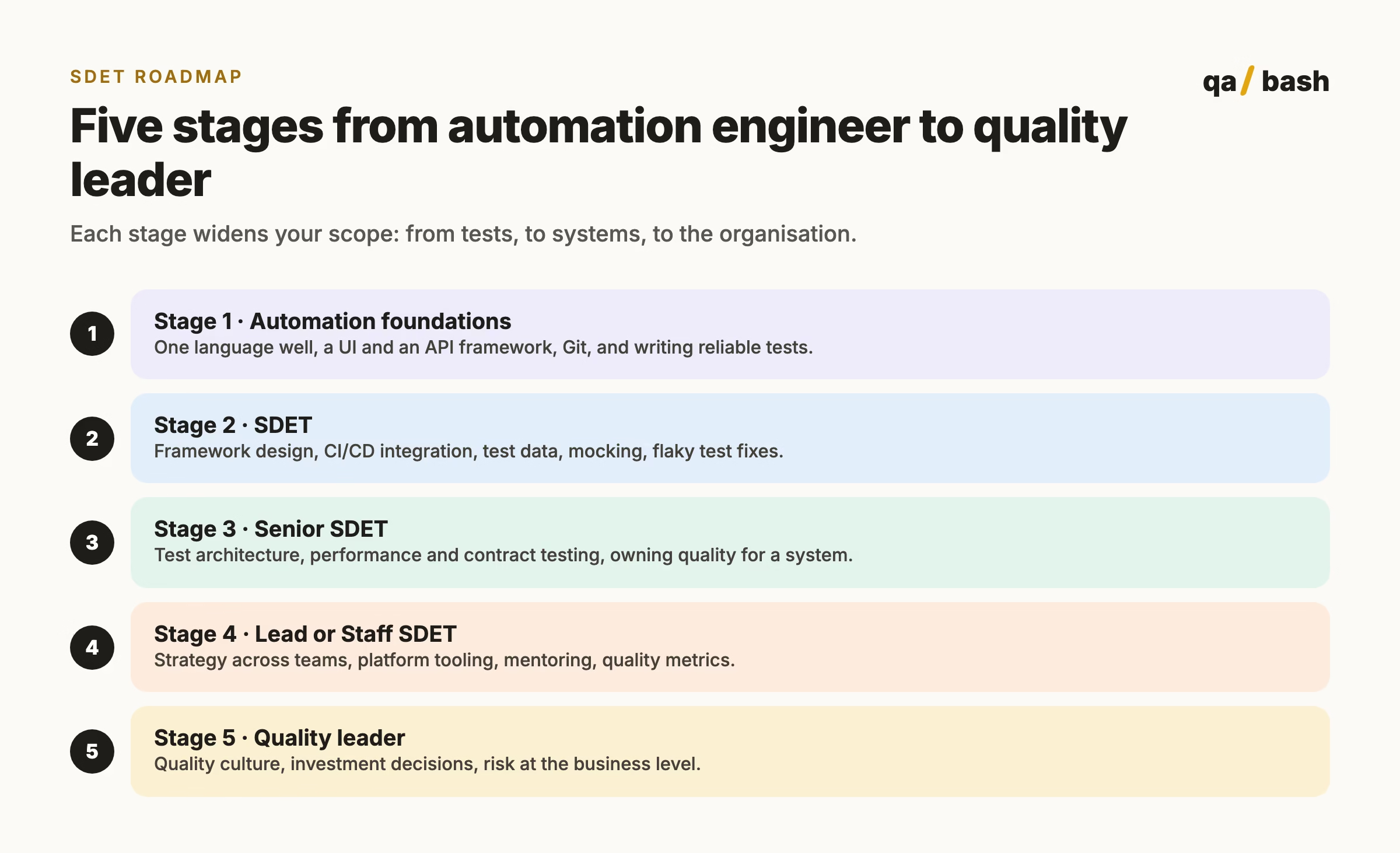
Stage 1: Automation foundations
- One programming language, properly: Java, Python or TypeScript. Data structures, OOP, error handling, reading other people’s code.
- UI automation: Playwright or Selenium, with a solid locator strategy and waits that do not depend on sleeps.
- API testing: HTTP fundamentals, REST Assured, requests or Playwright’s API client, schema validation.
- Git and code review: branches, pull requests, writing reviewable commits.
- Testing fundamentals: test design techniques, the test pyramid, writing clear bug reports.
Ready for the next stage when: your tests are trusted. When they fail, people believe there is a real problem.
Stage 2: SDET
- Framework design: page objects or screenplay, fixtures, configuration per environment, reusable helpers.
- CI/CD: running suites in GitHub Actions, GitLab CI or Jenkins, parallel runs, reports and artefacts.
- Test data and environments: seeding, cleanup, mocks and service virtualisation.
- Flaky test engineering: diagnosing timing, ordering and data causes instead of adding retries.
- Docker basics: running dependencies locally and in CI.
Ready when: other engineers add tests to your framework without asking you how.
Stage 3: Senior SDET
- Test architecture: deciding what is tested at unit, contract, API and UI level for a whole system.
- Contract and integration testing: Pact or similar, plus testing event-driven and async flows.
- Performance testing: k6, JMeter or Gatling, with realistic load models and clear pass criteria.
- Observability for testers: logs, metrics and traces to debug failures and verify production behaviour.
- Testing AI features: LLM testing, evaluation sets and prompt regression suites.
Ready when: you are invited to design reviews before code is written, because your input prevents defects.
Stage 4: Lead or Staff SDET
- Quality strategy across several teams, aligned to business risk rather than test counts.
- Platform thinking: shared test infrastructure, internal tools and paved roads other teams adopt.
- Metrics that matter: escaped defects, change failure rate, time to restore, suite reliability. See our guide to quality metrics engineering teams should track.
- Mentoring and hiring: growing other SDETs and raising the bar in interviews.
- Influence without authority: getting teams to change habits because the evidence is clear.
Ready when: teams you do not work in use the standards and tools you created.
Stage 5: Quality leader
- Quality culture: developers own testing; QA enables rather than gates.
- Investment decisions: where to spend on automation, tooling and people for the biggest risk reduction.
- Business risk: translating quality signals into language executives act on.
- Scaling quality: how to build quality at scale across engineering teams.
Skills by stage
| Skill area | Stage 1 | Stage 2 | Stage 3 | Stage 4 | Stage 5 |
|---|---|---|---|---|---|
| Coding | Solid basics | Framework code | Architecture | Platform tools | Reviews direction |
| Test design | Techniques | Suites | System strategy | Org strategy | Risk portfolio |
| CI/CD | Runs tests | Owns pipeline stage | Quality gates | Org-wide standards | Delivery metrics |
| AI in testing | Uses AI tools | Reviews AI output | Tests AI features | Sets AI policy | AI investment |
| People | Learns | Shares | Mentors | Leads and hires | Builds culture |
Common mistakes on the SDET path
- Collecting tools instead of going deep in one language and one framework.
- Writing many tests nobody trusts instead of fewer reliable ones.
- Hiding flaky tests behind retries rather than fixing causes.
- Measuring success by test count rather than defects prevented.
- Avoiding conversations with product and business, which caps you at Stage 3.
Keep your fundamentals sharp with five-minute challenges in the QA Bash Daily Testathon, and if you are wondering how AI changes this path, read will AI replace QA engineers.
Rate this article
8.1/10 average · 40 ratings
Discussion
Start the conversation
What do you think about this article? Share your experience, ask a question, or add to the discussion.

He’s a builder of communities, a collector of questions, and a relentless challenger of assumptions. While others chase answers, he chases better questions. While others talk about the future of testing, he quietly helps create it.
Frequently asked questions.
What is an SDET?
A Software Development Engineer in Test is an engineer who builds automation frameworks, test infrastructure and CI quality gates, writing production-quality code whose purpose is confidence in every release.
What skills does an SDET need?
A programming language, UI and API automation, Git, CI/CD, test design, test data management and debugging, plus architecture, performance testing and observability at senior levels.
Related articles

Tester to SDET: A Career Transition Roadmap
Navigating the Next Phase of Quality Engineering For many years, software testing was largely associated with…
5 min
The FEAR Framework for Structuring QA Interview Responses
Most Candidates Fail the First Question Many interview candidates spend weeks preparing Selenium questions,…
6 min